
As expected, on 30 October the Bank of Japan (BOJ) kept its policy rate on hold at 1.25%. The 8-1 vote—with board member Hajime Takata dissenting by voting for an immediate hike—may be interpreted as modestly more hawkish compared with September’s 7-2 split, when dissenters voted against a rate hike.
Hawkish dissent: The vote split is marginally more hawkish in that September’s dovish dissenters appeared to have accepted the current policy rate, while known hawk Takata argued in favour of a stepped-up pace of accommodation removal to bring rates more in line with “neutral”. Looking ahead, the BOJ Outlook Report reaffirmed that it will “keep raising rates in response to the economy and prices”.
Inflation consistent with target, wary of overshoot: Importantly, the BOJ confirmed in its October Outlook report that “underlying CPI inflation (is) at a level that is generally consistent” with the 2% price stability target. It warned that inflation expectations and corporate pricing behaviour could push inflation above target.
Good conditions to normalise risk asset holdings: Another hawkish signal was the central bank’s announcement that it would double the pace of ETF disposals as of 2027, although the rate of reduction, at an annual 0.1% of stock market trading value (or roughly 860 billion yen on a book value basis), would still take 43 years to complete. The BOJ emphasised current buoyant market conditions as a driver of the change, and also offered a caveat that sales may be adjusted or suspended depending on future financial conditions.
Forecasts: upgrade to 2027 inflation more significant than growth
The BOJ raised its FY26 growth forecast modestly from 0.6% to 0.7%, while lowering its FY27 outlook from 0.8% to 0.7%. More notably, it upgraded its FY27 core CPI median forecast from 2.4% to 2.6%, reinforcing concerns about upside risks to its 2% inflation target.
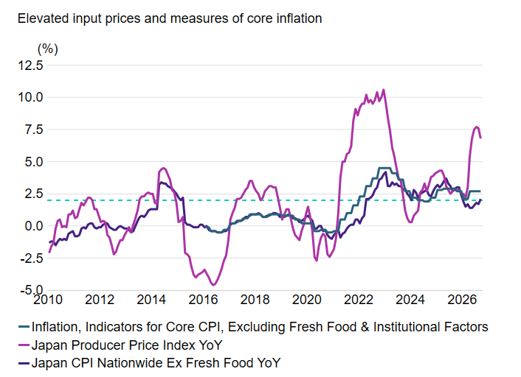
Both inflation drivers and risks appear inflationary: The BOJ explicitly identifies the possibility of inflation expectations and underlying inflation moving above target (which has now been reached). Energy costs, yen depreciation and AI-related demand were identified as potential sources of upside pressure. Below, we illustrate the potential for additional pass-through, although transmission is not automatic.
Chart 1: Core inflation-will renewed import-price pressures propagate through to consumer prices?
Source: Amova Asset Management, Japanese Statistics Bureau, Ministry of Internal Affairs & Communications, BOJ, Macrobond
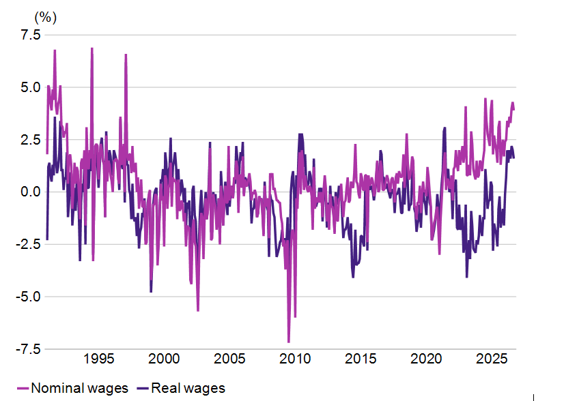
The BOJ expects consumption to remain relatively flat over fiscal 2026 before recovering as price pressures ease and the income-spending cycle strengthens. This underscores that nominal wage gains alone are insufficient to restore household confidence and that keeping inflation expectations contained is an important component of keeping real wage growth expectations intact.
Chart 2: Japan’s nominal and real wages, year-on-year change (%)
Source: Amova AM, Macrobond
Overall, the BOJ’s October decision broadly supports our expectations for ongoing tightening, which, at the time of writing, remain modestly below expectations for future hikes priced into the OIS market. In September, the median forecast of the Amova Asset Management Global Investment Strategy Committee (GISC) was for two additional hikes from the BOJ in the forthcoming 12 months, taking the policy rate to 1.75% by September 2027.
From GISC to FOMC: still over-weighting the US rate path?
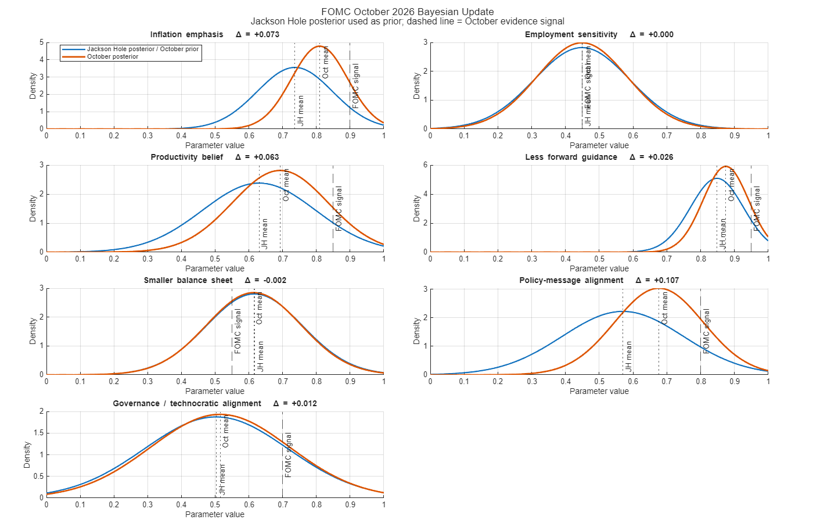
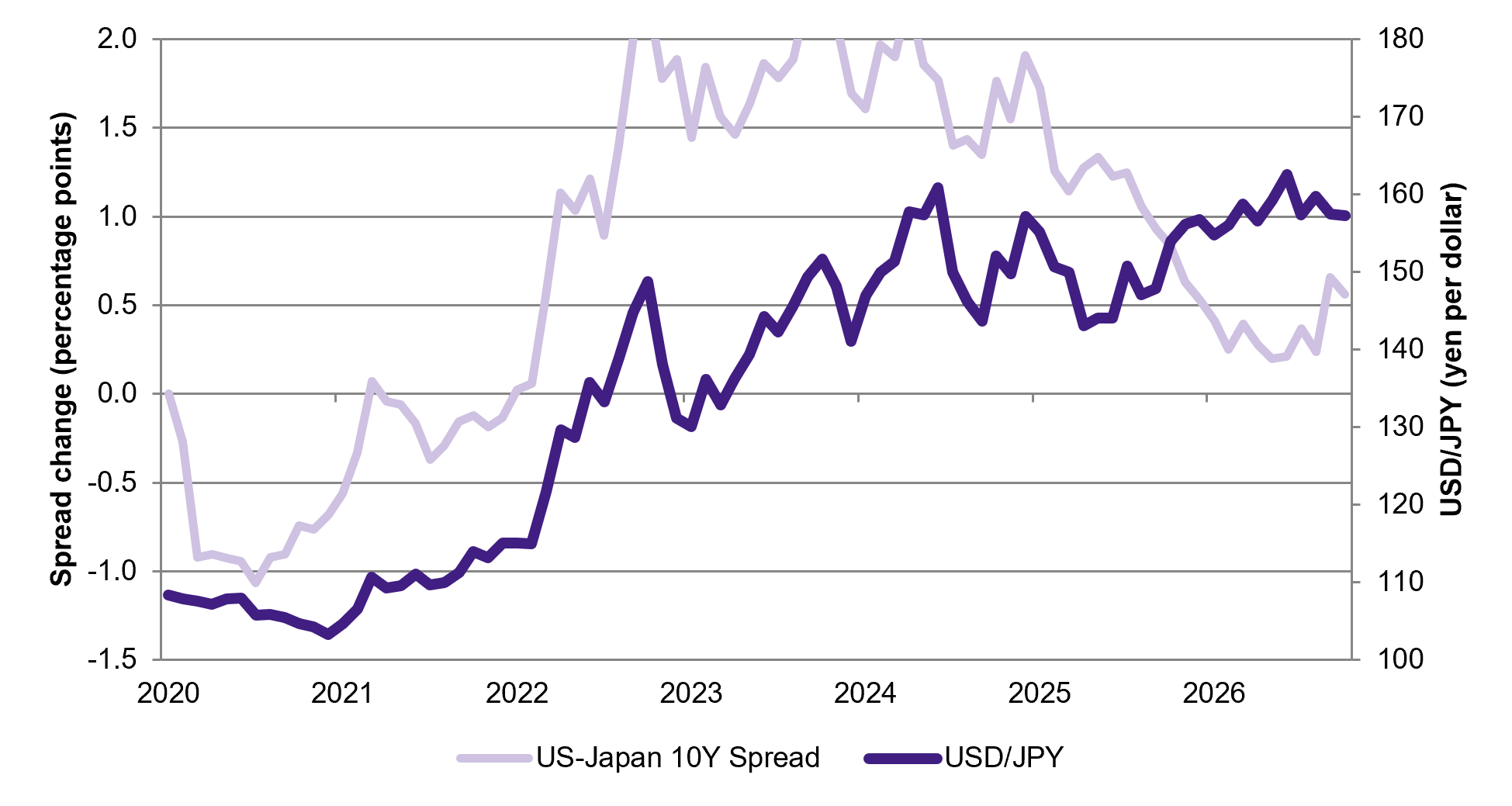
Dollar/yen’s immediate moves after the 30 October BOJ policy decision have been limited, which may indicate that the pair remains more influenced by expectations regarding the US economy and the Federal Reserve (Fed)’s corresponding rate trajectory. On 28 October the Fed delivered its own hawkish hold (voting 10-2 to keep rates at 3.75% to 4%), similarly emphasising upside inflation risks. Our own analysis indicates a rise in policy message alignment from the Fed, with an increase in inflation emphasis. Despite the repeated mention of a belief that productivity may keep inflation contained, Fed Chair Kevin Warsh explicitly acknowledged a need to refine his own understanding of US productivity via the upcoming Fed Productivity and Jobs Taskforce on 16 November.
Chart 3: US-Japan 10-year yield spread and dollar/yen
Source: Bloomberg
As mentioned in the GISC, the ongoing risk-tolerant expansion in global markets is disproportionately reliant on the trifecta of robust nominal US growth, extrapolation of currently buoyant earnings expectations and benign financing conditions, which encompass the widespread risk tolerance that we believe underpins the “carry trade”. With time, we expect tighter overall financial conditions to reduce the degree of accommodation buoying risk assets.
Appendix: Bayesian FOMC model update
The Fed kept rates on hold in October while retaining a hawkish message. We offer updates on specific criteria of interest identified in August.
- Policy-message alignment strengthened the most–Jackson Hole increasingly looks institutional, not personal:
October’s Federal Open Market Committee meeting reinforces the view that Warsh’s Jackson Hole framework is increasingly reflected in actual Fed communication and decision-making. While this strengthens our confidence that the two are aligned on monetary policy, it is not proof that the Committee has adopted every part of Warsh’s economic interpretation. - Inflation emphasis moved materially higher–the Fed is not using the productivity story to relax the inflation constraint: This importantly reinforces the first factor of interest. The meeting and press conference are jointly read as a hawkish pause, reinforced by the messaging at the press conference. Growth is tolerably strong (our employment sensitivity indicator remains little changed), but inflation remains the binding policy constraint.
- Productivity conviction rose, but important questions remain: Warsh and the Fed appear more convinced of a durable supply-side improvement, but what they mean by “productivity” is still somewhat unclear. At times, the FOMC has used “productivity” to refer to “labor productivity” while at other times it seems closer to “production”. Current production can indeed reflect more capital and strong demand, but neither establishes a durable acceleration in total factor productivity (which includes gains from technological innovation).
The bigger inconsistency would be the failure to address the possibility that if indeed productivity was rising in any durable way, the r-star could also be higher. That would point to a higher, not lower, neutral rate. So, the inconsistency here is that Warsh invokes the supply-side upside, but has not publicly closed the loop on the neutral-rate implication.
- Less forward guidance strongly confirmed: We had fairly high confidence to begin with that Warsh was not a fan of forward guidance, so the modest reinforcement of conviction is not surprising.
- Balance sheet and governance views remain weakly identified: These are mostly non-results. October did not reveal much about longer-run balance sheet preferences or how Warsh actually governs the Committee.
— Bottom line: confidence in alignment on inflation fighting is rising, but the productivity story has unresolved holes