


Japanese equity market no longer driven by a single AI narrative
It is no secret that AI-related stocks have been the main driver of the impressive surge in Japanese equities this year. At the same time, the advance by equities is broadening, as shown by the TOPIX reaching record highs in August (more on that in the second section of this report).
An easy explanation of the phenomenon is that the robustness of the AI and semiconductor-related sectors is spilling over to the broader market. This is clearly happening, but we need to understand that what we are witnessing is not a simple sector rotation away from AI-related stocks.
A better approach, in our view, is to recognise that the Japanese equity market’s advance is increasingly being driven by two distinct themes. The first remains the global AI and semiconductor cycle, where Japanese companies continue to occupy a niche in areas such as semiconductor manufacturing equipment, testing equipment and other critical components of the global technology value chain.
The second theme is a domestic reflation story. After decades in which labour, capacity and savings were in excess, Japan is now facing shortages of workers, capital and productive capacity. Persistent labour shortages are supporting a rise in real wage growth, which in turn is driving stronger consumption, greater business investment and increased demand for capital.
These two themes are largely independent. While there are overlaps in some areas—such as data-centre construction and AI-related capital expenditure—the domestic reflation story does not rely on continued upside in AI stocks. As a result, even if AI-related equities experience a correction, sectors more focused on domestic growth could continue to support the broader market.
The Japanese equity market is no longer driven by a single narrative. Rather, it is increasingly supported by both global technology demand and a domestic economy finally pulling away from the so-called “lost decades”.
Outperforming TOPIX provides exposure to Japan’s reflationary story
While the Nikkei Stock Average grabbed headlines earlier in 2026 by soaring to historic levels, the TOPIX has also come into the spotlight with its recent outperformance. The TOPIX (with dividends) gained nearly 4% in August, when it hit a record high, while the Nikkei (with dividends) rose 3% during a volatile month for the index.
The recent outperformance by the TOPIX reflects more than enthusiasm for AI and semiconductor stocks. Unlike the Nikkei, which has a greater concentration of high-priced technology-related shares, the TOPIX provides broader exposure to sectors that benefit from Japan's reflationary environment. Financials, real estate, construction companies, and other domestically focused sectors have become increasingly important contributors to index performance.
As a result, continued wage growth and improving real wages are likely to be more supportive of the TOPIX than the Nikkei. Rising household income, stronger consumption, increased capital expenditure and a steeper yield curve all contribute positively to sectors that have larger weights in the TOPIX.
Among foreign investors, the “Japan is back” narrative is no longer new. After looking primarily at the AI and semiconductor themes, foreign investors now appear to be gradually widening their focus on other areas, assessing Japan’s domestic recovery, improving corporate activity and broader economic normalisation.
While foreign investors have already increased their exposure to Japan, interest remains largely concentrated in large-cap names. Small- and mid-cap companies could eventually attract greater attention thanks to sustained real wage growth and stronger domestic demand, creating a new source of market support. The recent rise in the TOPIX suggests that investors are increasingly buying not just Japanese technology companies, but Japan Inc. itself.
Japanese stocks gain in August amid bounce in semiconductor-related shares
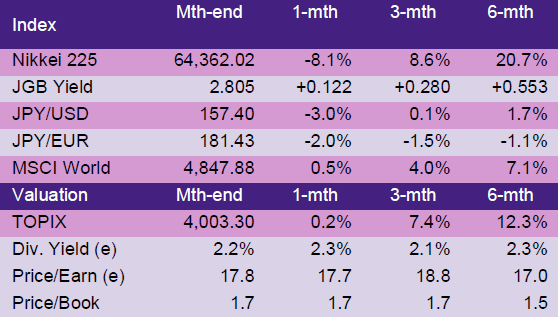
The Japanese equity market rose in August with the TOPIX Total Return Gross Index up 3.85% on-month and the Nikkei Stock Average (Nikkei 225) Total Return rising 3.09% (both in JPY terms). Share prices were somewhat weighed down by concerns over higher global interest rates amid uncertainty surrounding the situation in the Middle East, as well as by the preliminary April-June GDP growth figure for Japan coming in below market expectations. Overall, however, the market was supported by a number of positives, including semiconductor-related stocks being bought back at points when expectations for further US interest rate hikes receded. In addition, marine shipping stocks performed well on the view that maritime freight rates could remain elevated due to the prolonged confrontation between the US and Iran, while domestic demand-driven sectors, which are less sensitive to overseas economic conditions, also showed resilience.
Of the 33 Tokyo Stock Exchange sectors, 23 sectors rose with Services, Marine Transportation, and Nonferrous Metals among the most significant gainers. In contrast, 10 sectors declined, including Insurance, Glass & Ceramics Products, and Warehousing & Harbor Transportation Services.
Exhibit 1: Major indices
Source: Bloomberg, 28 August 2026
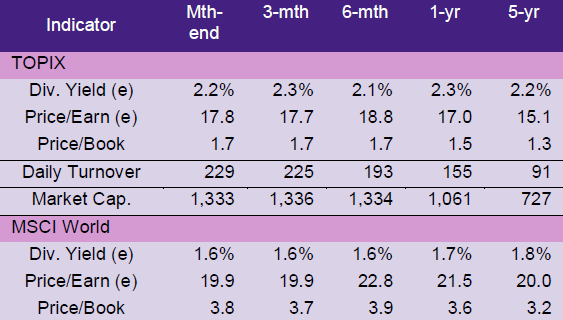
Exhibit 2: Valuation and indicators
Source: Bloomberg, 28 August 2026