


Both the Bank of Japan (BOJ) and the Federal Reserve (Fed) raised interest rates by 25 basis points (bps) at their monetary policy meetings this week, to 1.25% and 4%, respectively. The rate hikes were well anticipated by the market.
The BOJ decision announced on 18 September had been priced in almost completely by markets, and the delivery of a 7-2 decision in favour of the hike was accompanied by paring back of recent yen buying. Although the BOJ accelerated its hikes to “its fastest pace since 1990,” as cited by the media, whether the central bank quickens its pace from roughly two hikes a year to one every quarter remains contingent on how events unfold and how markets react. Questions of where both “neutral” and “terminal” policy rates sit are still open for debate.
BOJ: propagation signal is comparatively hawkish
The BOJ’s message in September is hawkish in diagnosis, rather than cadence; that is clear from the statement (and supported by the summary interim update to the economic outlook). While the framing of July’s decision and Outlook already contained language about upside risks from oil, AI and foreign exchange (yen weakness), according to September’s statement, underlying inflation could rise above 2% as firms become more inclined to raise wages and prices. This shift may be more meaningful in gauging policy development than September’s two dissents. Those dissents, from board members Toichiro Asada and Ayana Sato (both appointed by Japanese Prime Minister Sanae Takaichi), appeared to represent outlying views not entirely consistent with the updated Outlook.
September’s statement also noted that medium- to long-term inflation expectations have continued to rise. Taken together, the increasing persistence of inflation and the continued firming of expectations suggest that inflation is becoming more domestically driven, which is a hawkish signal. That said, the BOJ made it very clear in its statement that rates remain accommodative, and that it is in the process of removing accommodation rather than deliberately moving towards restrictive policy.
The inflation case is stronger than headline CPI
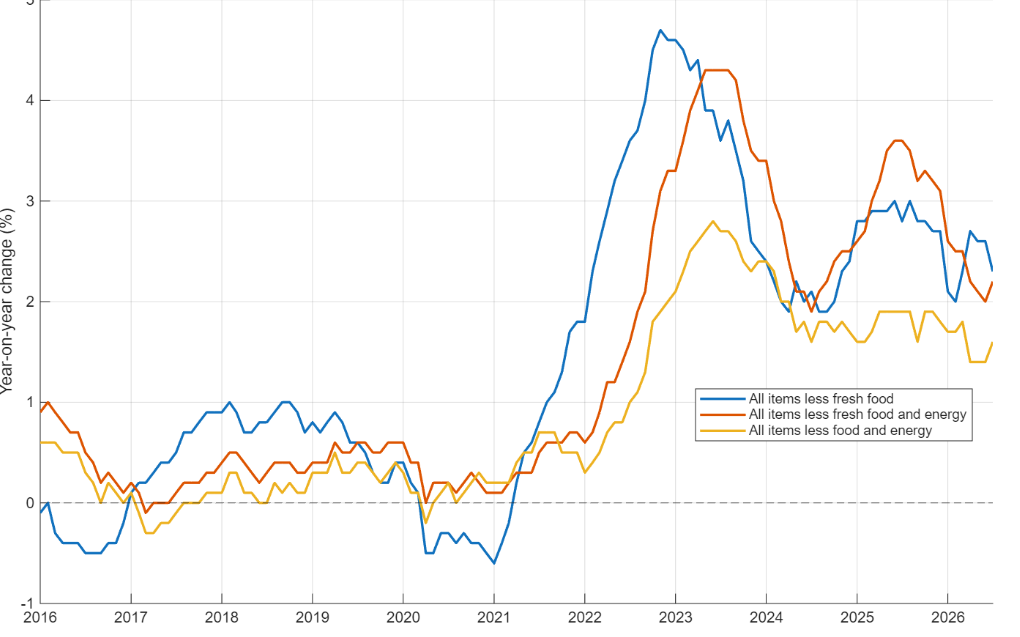
Although dissenting board member Asada cited recent CPI releases showing inflation below 2%, the underlying inflation case appears stronger than the headline figures suggest, even if core measures are not uniformly above 2%. Referring to the BOJ’s relatively new series of CPI excluding institutional factors, we might observe how energy has very recently placed downward pressure on CPI excluding fresh food, even after government subsidies are removed. Food prices, however, continue to exert upward pressure. In sum, the measures appear to support the BOJ’s wording that underlying inflation is “approaching 2%”.
Chart 1: BOJ’s CPI series excluding institutional factors

Source: BOJ, Amova Asset Management
Taken together, however, inflation dynamics do not show a uniform retreat in price pressures. Overall, the voting majority of BOJ policymakers most likely felt that the September hike was less about reacting mechanically to current headline CPI and more about preventing temporary or imported pressures (from energy, AI-related investment or foreign exchange movements) from becoming increasingly embedded through wages, expectations and broader price-setting.
Finding neutral: not there yet
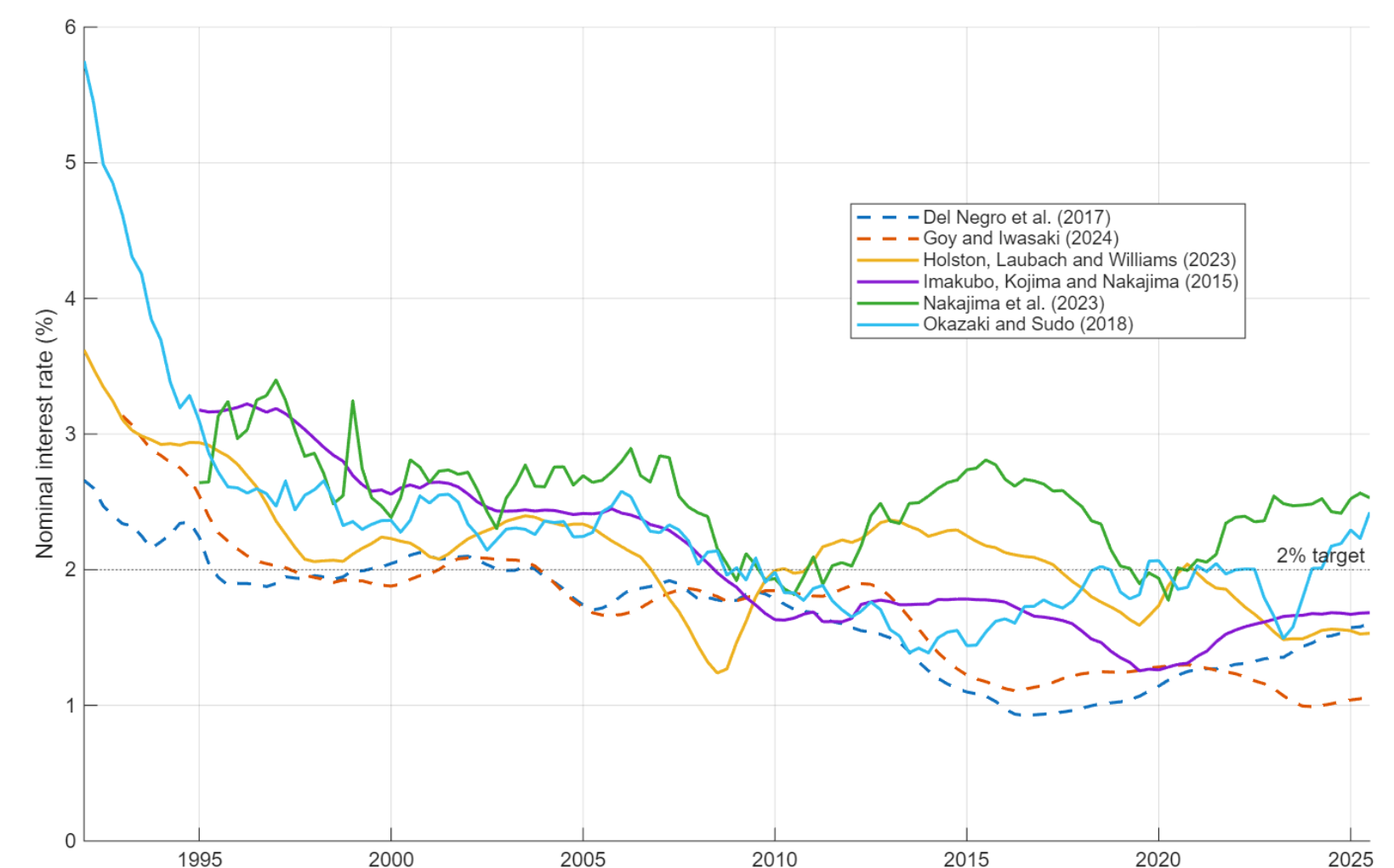
The illustrative models that the BOJ updates regularly on its website estimate the neutral policy rate (“r-star”) at roughly between -0.9% to 0.5%, which, in nominal terms, equate to approximately 1% to 2.5% when the central bank’s 2% inflation target is added back in. The most recent hike to 1.25% may give investors reason to place less confidence in the lowest estimate presented by Goy and Iwasaki (2024) shown below.
Chart 2: Implied nominal neutral rate estimates (r* + 2% target)
Source: BOJ, Amova AM
The safest assumption may be that we have entered the bottom of this very broad “neutral” range, but that accommodation has yet to be withdrawn. We note that a move to 1.5% (of which some probability is priced in before the year-end) may still put rates in the lower end of the “neutral” range; that level may also remain in accommodative territory.
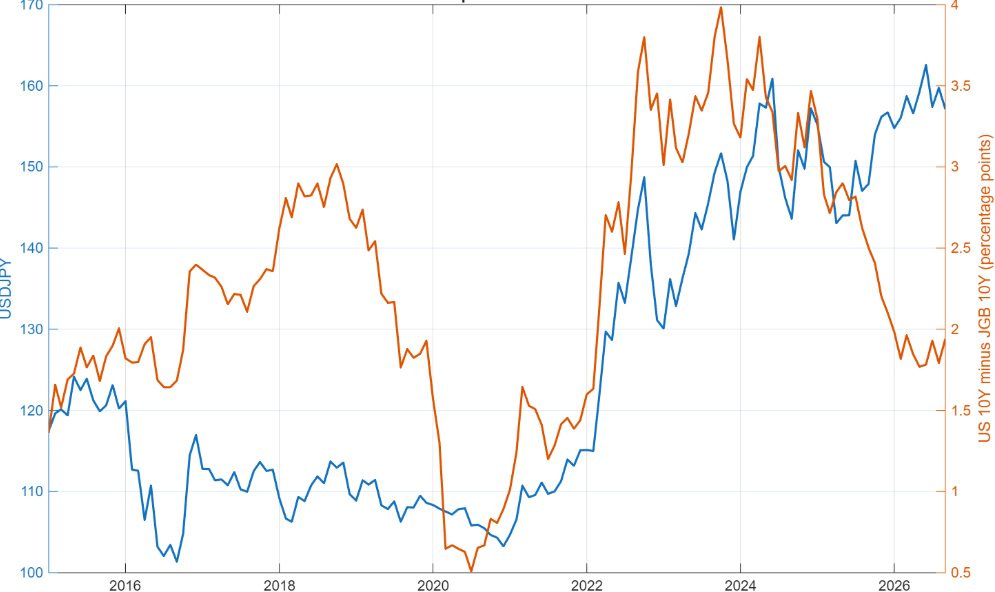
Chart 3: Dollar/yen and US-Japan 10-year yield differential

Source: Bloomberg, Amova AM
Yen exposure requires a global framework
Meanwhile, although the yen retreated from its recent gains after the well-anticipated rate hike was delivered from both central banks, it is also obvious that dollar/yen has not been visibly driven by relative rates for quite some time (see Chart 3). Although the BOJ has been hiking rates slowly but steadily since March 2024 and the Fed has only recently started hiking, a narrower spread has not automatically led to yen appreciation. This suggests that the exchange-rate transmission channel of BOJ tightening is weaker than a textbook carry trade story would imply.
However, recent market moves are still consistent with our cross-market analysis (see The yen: carrying the weight of the world’s risk tolerance). We may observe that although relative rates are not visibly moving dollar/yen lately, higher US Treasury yields are, emphasising the yen’s value as a cheaper funding currency. This means that funding conditions and risk tolerance also matter alongside bilateral rates.
FOMC: higher for longer, but how much?
The 15-16 September Federal Open Market Committee meeting outcome strengthened our inflation-constrained higher-for-longer thesis (see Jackson Hole: Fed credibility intact). The Committee reinforced Fed Chair Kevin Warsh’s increased focus on inflation, and reinforced expectations of policy rates remaining elevated even after the September hike.
In his comments, Chair Warsh explicitly linked the unanimous decision to insufficient progress in underlying inflation, providing supporting evidence for the reaction function we previously outlined. The September Summary of Economic Projections also conveyed a more restrictive policy outlook. The median projection for the Federal Funds rate at end-2027 rates rose from a midpoint of 3.6% in June to 4.1%, although it remained flat compared to the year-end projection for 2026. Median forecasts for core PCE inflation in 2026 were revised higher compared to June.
Even so, higher policy rates do not automatically mean borrowing and investment are being restrained. Credit can remain readily available, and investors may continue to take on risk despite higher rates. Over the longer term, however, the direction for policy is removal of accommodation. The impact of higher rates on borrowing, spending and risk-taking will be measured over quarters to come.
Not all markets are pricing “higher for longer”
That both central banks are raising rates is a clear indicator of their intentions to gradually withdraw the accommodation that has underpinned the surge in risk assets. But risk assets are not reacting proportionally to such signalling yet. Consequently, an undervalued yen may remain weak even as the BOJ normalises, though dollar/yen remains very sensitive to any shift in risk sentiment or assumptions about future funding conditions. Persistent yen weakness, in turn, could continue to feed import and wholesale-price inflation even as the policy-rate gap is narrowing. All else equal, this may support faster hikes or higher terminal rates.
Longer-term, with rates rising not only in Japan but also in the US, the forward indicator is one of eventually tighter financial conditions, which means it will become increasingly tougher for “carry trades” to persist at the same magnitude.