


As inflation and interest rates move structurally higher, the relative performance of Singapore equities, REITs and bonds is likely to shift—raising important implications for asset allocation.
A decade of diverging outcomes
Singapore investors have traditionally allocated across equities, REITs and fixed income to achieve diversified income and growth. However, the relative attractiveness of these asset classes has shifted meaningfully in recent years, shaped by changing interest rate dynamics and broader macroeconomic trends.
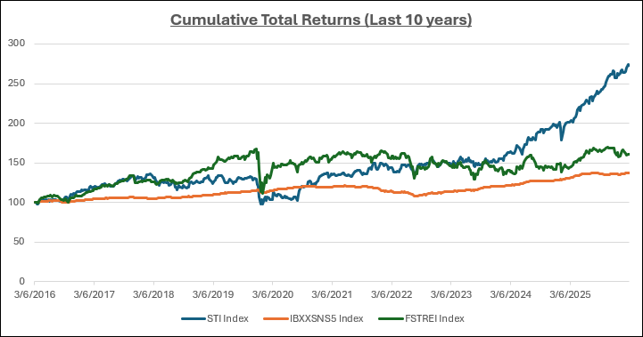
An examination of benchmark indices representing each asset class—the STI Index (equities), FTSE ST All-Share Real Estate Investment Trusts Index (REITs) and iBoxx SGD Non-Sovereigns Investment Grade Index (bonds)—highlights distinct return patterns over time.
Over the past 10 years, Singapore (SG) equities have generated annualised returns of approximately 10.6%, outperforming both SG REITs (4.9%) and SG bonds (3.2%). This outperformance was particularly pronounced in the most recent five-year period, in which equities delivered 15.1% annualised returns.
REITs, by comparison, performed more strongly in earlier years, benefiting from a prolonged low-interest-rate environment that supported valuations and income demand. However, performance has moderated in the post-pandemic period amid rising interest rates.
Bonds have remained comparatively stable throughout the cycle, delivering lower but more consistent returns across most periods.
Chart 1: Comparing cumulative total returns of asset class benchmarks
Source: Bloomberg, June 2026
Risk and risk-adjusted returns
Volatility and risk-adjusted metrics provide further context for asset allocation decisions.
Singapore bonds exhibit the lowest volatility, with long-term annualised volatility of around 2–3%. Equities carry higher volatility (around 12.9% over 10 years), while REITs have demonstrated even higher volatility than equities across most periods.
From a risk-adjusted perspective (as measured by Sharpe ratios), equities have remained competitive, particularly in recent periods. While bonds have shown stronger Sharpe ratios over certain longer horizons, this reflects their lower volatility rather than higher absolute returns.
For investors, this underscores a key trade-off:
- Bonds offer stability but may fall short of return targets.
- Equities provide higher return potential, albeit with greater variability.
- REITs sit between the two but are increasingly sensitive to interest rate movements.
Table 1: Annualised volatility of asset class benchmarks

Source: Bloomberg, June 2026
Table 2: Sharpe ratio of asset class benchmarks

Source: Bloomberg, June 2026
Income considerations
Income remains a central component of Singapore portfolios.
Based on Bloomberg data, as at June 2026, SG REITs have historically provided the highest yields, averaging around 5.8%, followed by SG equities at approximately 4.2% and SG bonds at around 2.7%.
This positioning has traditionally made REITs attractive for income-focused mandates. However, higher financing costs and yield competition from fixed income have weighed on their relative appeal in recent years.
Equities, while offering lower headline yields than REITs, provide a combination of income and earnings growth, which can support total return over longer horizons.
Macro outlook: a higher-for-longer regime
Looking ahead, we expect the macro environment to play a critical role in shaping asset class performance.
We see two structural trends that could support a higher inflation regime over the next decade:
- Geopolitical fragmentation, which could lead to less efficient global supply chains and higher production costs.
- Resource demand linked to digitalisation and electrification, requiring significant inputs such as metals and energy-related materials.
In such an environment, interest rates may remain structurally higher than in the previous decade.
This has differentiated implications across asset classes:
- Bonds and REITs may face headwinds due to higher discount rates and funding costs.
- Equities, particularly companies with pricing power and earnings growth, may be better positioned to absorb inflationary pressures.
Structural tailwinds for Singapore equities
Beyond macro factors, domestic policy initiatives may also influence relative performance.
In our view, the Singapore Government’s Equity Market Development Programme (EQDP) could support the local equity market by:
- Improving market liquidity and increasing capital market activity
- Attracting growth-oriented companies and IPOs (initial public offerings)
- Enhancing representation of emerging sectors
Over time, we believe mid- and small-cap companies could play a larger role in market development, particularly in sectors such as renewable energy, data infrastructure, technology and logistics. We expect these sectors to be important pillars of Singapore’s future economic growth and to contribute to the ongoing evolution of the Singapore equity market.
Portfolio implications
The evolving landscape suggests that traditional assumptions around asset class roles may warrant reassessment.
- SG equities may continue to play a central role in delivering return and capturing nominal growth.
- SG REITs remain relevant for income, but their performance may be more cyclical and rate-sensitive than historically observed.
- SG bonds continue to provide diversification and capital stability, though return expectations may remain modest.
Importantly, relative performance across these asset classes is unlikely to be static and will remain dependent on macro conditions, policy developments and market cycles.
Conclusion
Singapore equities, REITs and bonds each fulfil distinct roles within portfolios. While equities have demonstrated stronger return potential in recent years, REITs and bonds continue to provide diversification and income.
In a higher inflation and interest rate environment, we believe equities may be comparatively well positioned, supported by earnings growth and structural policy tailwinds. However, diversification across asset classes remains critical, particularly given uncertainties in the macroeconomic outlook.