

Articles

Escalation in Iran encounters market disbelief

Markets calm for now, but potential for volatility should not be dismissed
/images/default-source/global-library/authors/naomi-fink37b66e2e-615b-4a7c-ab6a-112269e089d0.tmb-medium.jpg?Culture=en&sfvrsn=a98a66c6_2
Naomi Fink
Chief Global Strategist
02 March 2026
3 min read
/images/default-source/global-library/insights/2026/thumbnails/2603-escalation-in-iran-encounters-market-disbelief.tmb-rs800x600.png?Culture=en&sfvrsn=952c4fd8_1
Both the equity and bond markets seem to be pricing in a limited conflict following the strike on Iran by the US and Israel. However, it would be unwise to discount the potential for further volatility ahead.

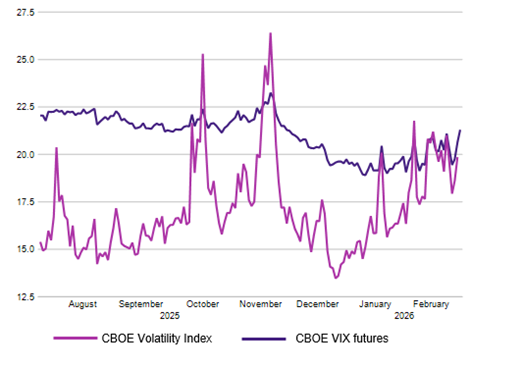
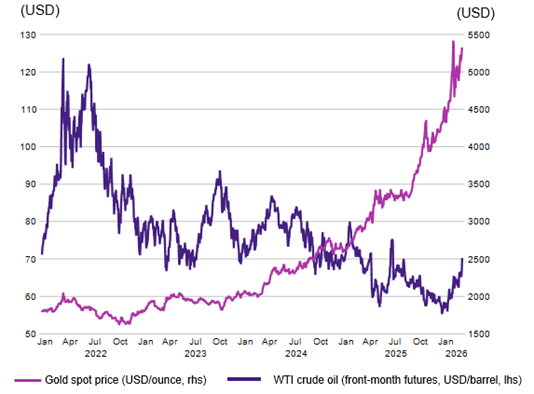
The US and Israeli strikes on Iran that began on 28 February and Tehran’s retaliatory strikes throughout the Middle East triggered a sell-off in Asia equity markets. As of the time of writing, US stock futures have also declined sharply and VIX futures have risen (see Chart 1). Oil prices have surged, while traditional safe haven gold has rebounded to near record highs (see Chart 2).

Chart 1: VIX futures edge up after strikes
Source: Amova Asset Management, Bloomberg

Chart 2: Oil climbs, gold bounces back
Source: Amova Asset Management, Bloomberg

Both equity and bond markets, however, seem to be pricing in a limited conflict. At the time of writing, risk appetite has shown signs of only limited strain. This is surprising, given the immediate scope of the conflict and the uncertainty of the outcome.

For example, the rise in the generic front-month VIX futures has been comparatively modest so far. The rise seen up to now does not appear out of the ordinary, compared to recent history (See Chart 1);  higher levels were observed as recently as November 2025.  Meanwhile, the futures curve remains in contango formation, with contracts trading above spot—which is characteristic of times of contained volatility, rather than the backwardation that accompanies episodes of systemic volatility. However, this may change in future sessions and is worth watching as a sentiment indicator.

For Japanese equities, the US-Israeli attack on Iran does not appear to be the sole risk factor weighing on sentiment. Weakness in financial sector stocks was attributed by the media only partly to the rise in geopolitical risk. The weakness also reflects shifting expectations around the Bank of Japan’s rate hike trajectory, growing concern over the health of credit markets and uncertainty over domestic fiscal policy credibility.

Notably, the yen, a traditional risk haven, remains mostly unaffected by the strikes. This indicates that either (a) risk aversion has yet to rise to a level that would prompt broad-based unwinding of the yen-funded “carry trade”, with markets foreseeing the escalation of geopolitical tensions as unlikely to lead to a wholesale collapse in risk appetite; or (b) that Japan’s cash-hoarding days are over, and that geopolitical tensions, with their potentially inflationary implications and pressure on real interest rates, may undermine the yen’s value in the absence of future rate hikes.

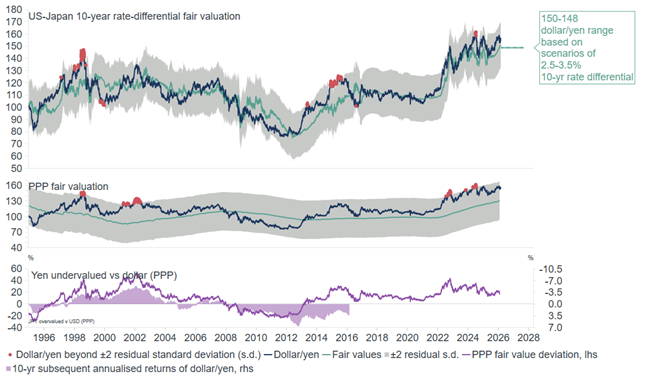
That said, as Chart 3 shows, dollar/yen is above “fair value” on both long-term and shorter-term measures, implying that the yen remains undervalued.

Chart 3: Dollar/yen above “fair value”
Source: Macrobond, US Treasury, BLS, SBJ

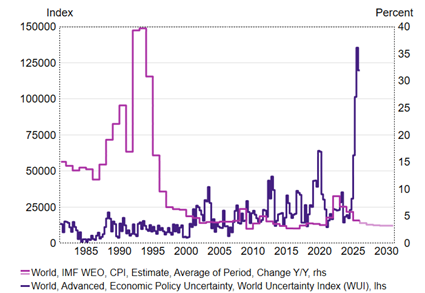
In the longer term, the relationship between uncertainty and prices remains a key factor of the outlook for risk assets, as well as both for the dollar and the yen. The recent increase in volatility remains modest compared to many measures of economic uncertainty (see Chart 4), and there is some evidence that a rise in different types of policy uncertainty tends to foster, with some lag, higher inflation*.

Chart 4: Latest volatility increase remains modest relative to many measures of economic uncertainty
Source: Amova AM, Economic Policy Uncertainty, International Monetary Fund

It is therefore possible that the markets have yet to fully price in this shift, even though the risk reaction so far has been relatively muted. It would be unwise to discount the potential for further volatility ahead.

* For example, see. Dreschsel, 2024 (on uncertainty surrounding political pressure on the Fed) and Gavriidis, 2026  (which finds effects consistent with a supply-side shock in climate policy uncertainty).

Related Insights

The information on this website is for informational purposes only and is not intended to be an offer, or a solicitation of an offer, to buy or sell any product or service to any person in any jurisdiction where such offer, solicitation, purchase or sale would be unlawful under the laws of such jurisdiction.

Moreover, the information in this website will not affect Amova Asset Management America, Inc.’s (“Amova AM”) investment strategy in any way. The information and opinions in this website have been derived from or reached from sources believed in good faith to be reliable but have not been independently verified. Amova AM makes no guarantee, representation or warranty, express or implied, and accepts no responsibility or liability for the accuracy or completeness of this document. No reliance should be placed on any assumptions, forecasts, projections, estimates or prospects contained within this document. This website should not be regarded by recipients as a substitute for the exercise of their own judgment. Opinions stated on this website may change without notice.

In any investment, past performance is neither an indication nor guarantee of future performance and a loss of capital may occur. Estimates of future performance are based on assumptions that may not be realized. Investors should be able to withstand the loss of any principal investment. The mention of individual securities, sectors, regions or countries within this document does not imply a recommendation to buy or sell. All information contained in this website is solely for the attention and use of the intended recipients. Any use beyond that intended by Amova AM is strictly prohibited.

This website may contain links to the website of certain overseas affiliates of Amova Asset Management Americas, Inc. (“Amova AM”). However, providing such links should not be considered as offering or solicitation by Amova AM of any product or service of its affiliates to any person.

Additional information can be found under the Disclaimers [https:us.amova-am.com/institutional/legal-privacy-policy/disclaimer] section of this website.

US
This website is for information purposes only and is not intended to be an offer, or a solicitation of an offer, to buy or sell any investments or participate in any trading strategy. An offering of any investments, securities or investment advisory services with respect to securities may only be made by receipt of relevant and complete offering documentation and agreements, as applicable. Any offering or distribution of a Fund in the United States may only be conducted via a licensed and registered broker-dealer or a duly qualified entity. Amova Asset Management Americas, Inc. is a United States Registered Investment Adviser. 

Canada
The information on this website should not be considered a solicitation to buy or an offer to sell a security in Canada. The information provided herein does not constitute any form of financial opinion or investment advice on the part of Amova AM and it should not be relied on as such. It does not constitute a prospectus, offering memorandum or private placement memorandum in Canada, and may not be used in making any investment decision. Additional information can be found under the Disclaimers section of this website.